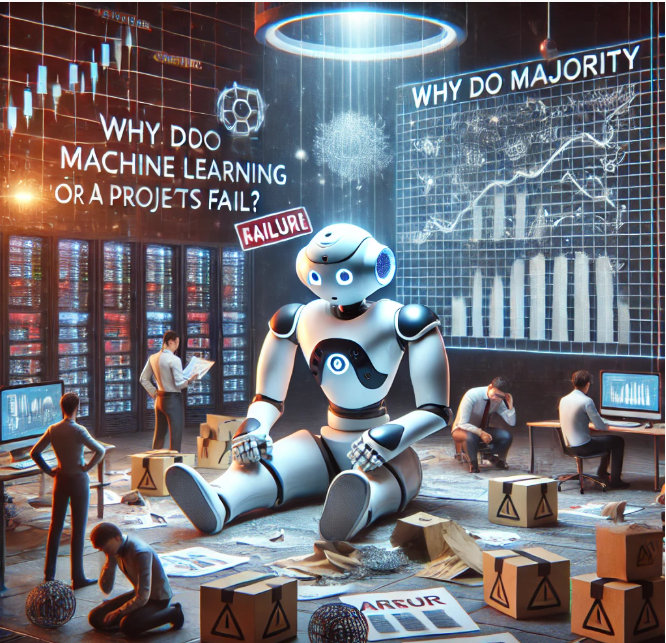
The failure rate is not a technology problem. It is a strategy problem, a data problem,
a people problem — and a governance problem. We know exactly why it happens.
And how to prevent it.
Every week, organizations announce ambitious AI initiatives. Most of them will not make it to production.
The
85%
(opens in a new tab) failure rate is not the result of bad AI models or insufficient computing power.
It is the result of predictable, recurring strategic and organizational failures that happen
long before any model is trained.
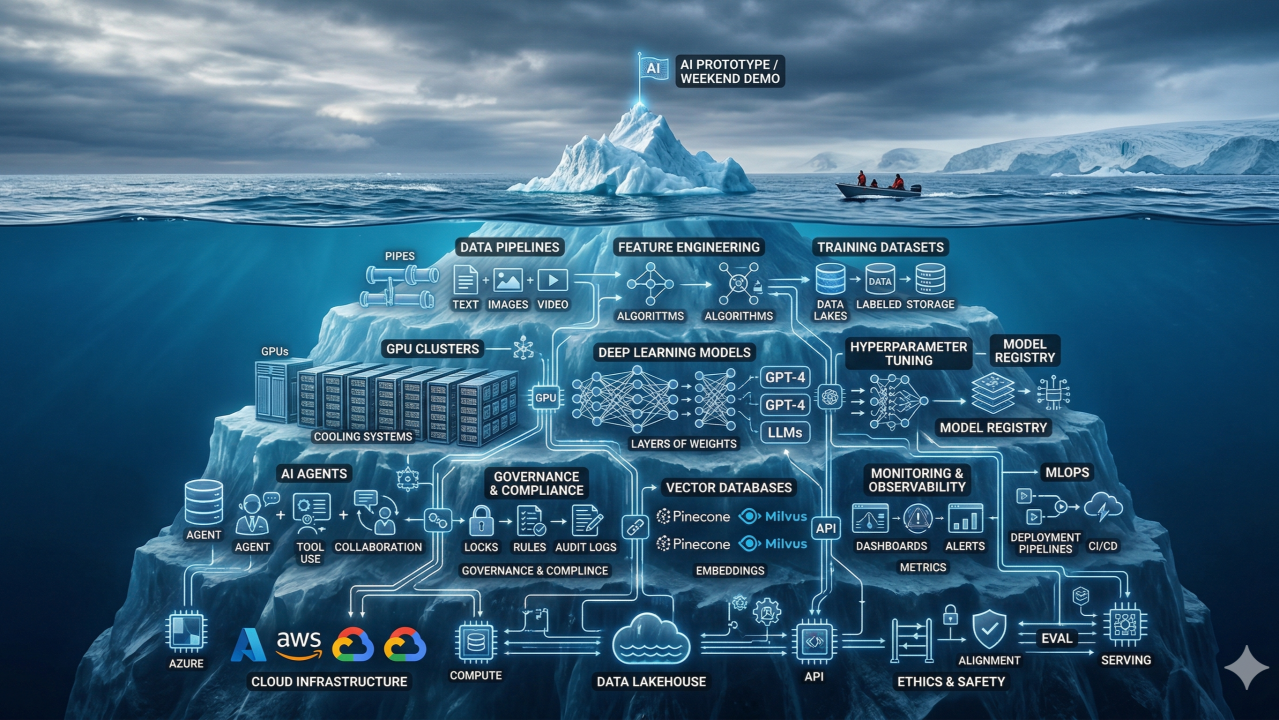
Organizations fail at AI because they skip the foundational work. They pursue technology
before defining use cases. They invest in tools before assessing their data. They deploy pilots
without scalable governance. They measure success in demos rather than operational outcomes.
At 2Create360, we have studied these failure patterns in detail. The six root causes below
are not theoretical — they represent the consistent, repeatable reasons organizations
find themselves with expensive AI experiments that never make it into production.
Understanding them is the first step to avoiding them.
6
Root Causes Identified
// The Six Root Causes
Why AI Projects Fail to Deliver
These are not edge cases. They are the consistent, documented reasons behind the
85%
(opens in a new tab) failure rate —
observed across industries, organization sizes, and technology budgets.
01 /
Lack of Clear Strategy & Objectives
The absence of a robust AI strategy and a well-defined roadmap is the primary cause of failure.
Without clear objectives, organizations design solutions that address no specific need and measure success by no meaningful metric.
34%of senior executives report strategy fully aligned with business goals
02 /
Data Readiness & Quality Issues
Data is the foundational ingredient for AI success — yet it is almost universally underestimated.
Poor quality, inaccessible, and siloed data dooms even the most technically sophisticated initiatives.
47%of CXOs identify data-readiness as their top challenge
Inaccurate or biased training data leads to unreliable outputs
Fragmented data silos block enterprise-wide AI scaling
A critical scarcity of AI skills is compounded by a common organizational mistake —
the "single scientist" error, where one person is expected to do the work of an entire
cross-functional engineering and data team.
78%of senior leaders struggle to find specialized AI skill sets
PoCs built without DevOps and backend support rarely reach production
Only 37% of organizations are actively upskilling their workforce
04 /
Integration & Scaling Complexities
Moving from successful pilot to full-scale production is where most organizations discover their
AI initiative was never truly designed to scale. Workflow disruption and legacy system complexity
are the final barriers.
9%of companies have fully deployed an AI use case at enterprise scale
05 /
Ethical, Security & Trust Risks
Responsible AI is not a compliance checkbox — it is a deployment prerequisite.
AI systems that lack transparency or exhibit bias lose stakeholder trust, attract
regulatory scrutiny, and are ultimately abandoned.
AI "hallucinations" create serious liability in live environments
Data privacy concerns prevent confident deployment
Biased outputs damage reputations and erode employee trust
06 /
Unrealistic Expectations & Cost
Businesses often enter AI initiatives expecting immediate, transformative results — "magic" from the technology.
When results require time, iteration, and investment, projects are cancelled before they have
the opportunity to deliver.
The high initial costs of infrastructure and talent acquisition compound this problem.
Without a clear framework for demonstrating measurable financial returns early —
through phased delivery and milestone-based validation — executive patience runs out
before value is proven.
"The organizations achieving the greatest success with AI are not those investing the most
in technology. They are those approaching it with strategic discipline,
operational clarity, and measurable business objectives."
Every one of the six root causes is preventable. Our approach is structured
specifically to address each one — before it becomes a project-ending problem.
01
Business-First Strategy & Scoping
We begin with operational value discovery and feasibility assessment — ensuring every AI initiative is grounded in measurable business objectives before any technology is selected
02
Data Readiness Assessment
We audit your data ecosystem before deployment — identifying quality gaps, governance weaknesses, and integration barriers that would otherwise surface at the worst possible moment
03
Full Cross-Functional Team
We provide strategy, engineering, data science, DevOps, and change management — not a single consultant expected to carry an entire transformation alone
04
Phased Delivery with Proven Value Gates
Our lifecycle model validates value at each phase before advancing — ensuring stakeholder confidence is earned through results, not promises
05
Governance & Responsible AI by Design
Ethics, transparency, security, and compliance are built into every phase — not retrofitted after problems emerge in production
// Don't Become a Statistic
Your AI Initiative Deserves to Succeed.
The
85%
(opens in a new tab) failure rate is real — but it is not inevitable. With the right strategic foundation,
the right team, and the right approach, your organization can be in the 15% that delivers.